
A Disconnect Between Economic Headlines and Equity Markets
The first half of 2026 highlighted the gap that can exist between headlines and economic reality. Despite extensive media attention surrounding geopolitical tensions in the Middle East and fluctuations in oil prices, the global economy proved more resilient than expected.
Corporate earnings remained strong, supported in particular by investments in artificial intelligence, which continued to drive spending on data centres, semiconductors, and energy infrastructure. Although inflation remained persistent and geopolitical uncertainty contributed to market volatility, central banks maintained a cautious approach to interest rates. At the same time, market leadership gradually broadened beyond the largest U.S. technology companies, benefiting the natural resources and infrastructure sectors, as well as several international markets.
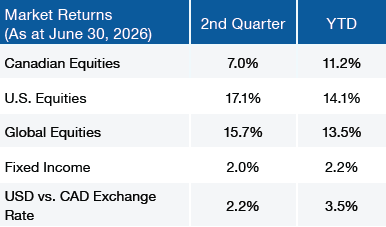
RETURNS ON MAJOR ASSET CLASSES (CAD)
Canadian Equities
Canadian equities delivered an excellent first half of 2026, as reflected by the 11.2% return of the S&P/TSX Composite Index.
The energy sector was the primary driver of this performance. Constraints on global oil supply supported crude oil prices for much of the period, benefiting Canadian producers.
The financial sector also generated strong returns. Despite a challenging interest rate environment, banks and insurance companies continued to benefit from their stability and profitability, creating value for shareholders.
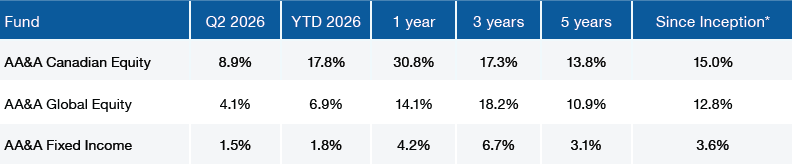
Since the beginning of 2026, the AA&A Canadian Equity Strategy has significantly outperformed its benchmark index. This outperformance was driven primarily by stock selection in the materials, industrials,health care, information technology, and consumer staples sectors.
Global Equities
Global equity markets finished the first half of the year with strong gains, supported by a combination of resilient economic growth and solid corporate earnings.
Investment in artificial intelligence remained the dominant theme of the period. However, the beneficiaries of this trend gradually broadened beyond the “Magnificent Seven.” Semiconductor and memory manufacturers, energy infrastructure companies, industrial equipment suppliers, and data centre providers increasingly contributed to market performance.
Overall, companies reported results that exceeded expectations, allowing markets to maintain elevated valuations despite ongoing geopolitical risks and inflationary pressures.
Unlike our Canadian Equity Strategy, our Global Equity Strategy delivered a return below that of its benchmark index. This underperformance was mainly attributable to our underweight position in the technology sector, as well as stock selection within the consumer staples, consumer discretionary, and industrials sectors.
Fixed Income
Higher energy prices and continued economic resilience increased inflationary pressures above central bank targets. As a result, market expectations shifted from a scenario of near-term rate cuts to one characterized by stable policy rates, and potentially even additional rate increases.
Against this backdrop, the Canadian bond market generated a return of 2.2% at midyear.
The AA&A Fixed Income Strategy delivered a slightly lower return than its benchmark index, primarily due to the portfolio's shorter duration.
FUND RETURNS (SERIES O) AS AT JUNE 30, 2026
Outlook
In a future article, we will share our thoughts on the implications of artificial intelligence. We believe this technology has the potential to increase productivity and improve quality of life over the long term. As equity investors, we view this transformation as an important source of value creation for decades to come.
In the shorter term, one can envision a scenario in which repeated delays to a potential peace agreement between the United States and Iran lead markets to adopt more cautious assumptions regarding economic growth and more aggressive assumptions regarding oil prices and inflation.
We remain confident in the long-term return potential of the companies held in our portfolios. In addition to being profitable and operating proven business models, these companies have strong balance sheets, reasonable valuations, and a significant capacity to generate cash flow.
Author(s)