


There is no set age at which financial conversations should begin. What matters most is adapting the message to your child's level of understanding and revisiting the topic regularly. Financial concepts can be introduced from a very young age. It's all about using the right approach and examples.
By age five, children already understand the concept of exchange: getting something in return for something else. This is the ideal time to demystify money and prevent it from becoming a taboo subject. But how can you introduce the concept in a practical way?
Let your child handle coins and count change at the corner store.
Play with a toy cash register or set up a pretend store.
Explain in simple terms: "Mom and Dad go to work to earn money, and that money helps us buy the things we need."
Teaching children that something expensive is not necessarily valuable, and vice versa, is a lesson that will serve them throughout their lives. In investing, the value of an asset is measured by the long-term benefits and returns it generates, not by its purchase price. Applied to everyday spending decisions, this distinction can help children recognize the difference between an impulse purchase and a thoughtful investment.
This is when children begin to understand the relationship between work and financial reward. Here are a few simple habits to encourage:
Introduce an allowance tied to real responsibilities (taking out the trash, shovelling snow, etc.).
Give them a small budget for a specific purchase — clothing, for example. The goal isn't for their decisions to be perfect; it's for them to learn.
Encourage them to make trade-offs: would they rather buy two expensive items or five more affordable ones? Simple choices like these teach prioritization.
An allowance given without effort has limited educational value. Providing compensation for a genuine contribution, even a modest one, helps build a lasting connection between work and money.
First job, first bank account, first tax return. Your teenager is ready to move from learning about money to managing it. This is the ideal time to introduce systematic saving, registered accounts, long-term investing and the basics of taxation. They should understand that these lessons are designed to provide the building blocks for a strong financial future.
One of the best ways to introduce a child to saving is to guide them towards making rational decisions on their own. Take a scooter, for example. Instead of buying it for them right away, encourage them to save $10 a week toward the purchase. After 30 weeks, they'll have enough to buy it themselves.
Along the way, they'll learn valuable lessons about patience, planning and making thoughtful spending decisions. They may even decide they no longer want the scooter by the time they've saved enough money, which is part of the lesson. We call it deferred gratification: the ability to resist an immediate reward in favour of a greater, more lasting benefit.
"An allowance handed out with no expectations attached has limited educational value. Tying money to age-appropriate responsibilities, such as taking out the garbage, shovelling the driveway or helping a neighbour, helps children understand the connection between effort and earnings."
Compound returns are the single most important concept in investing. And they can be explained simply, even to a ten-year-old. Here is a table illustrating the principle:
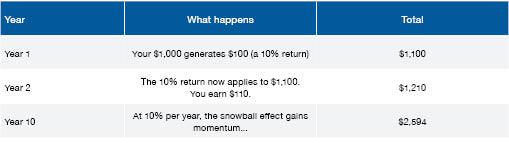
Money can work for you, and the concept is easy to understand. Like a snowball rolling downhill, your savings can grow larger over time as your returns begin generating returns of their own. Without adding another dollar, your capital can more than double. That's the power of time and compound returns working together.
The Rule of 72 is a formula that approximates the number of years required to double your savings. Just divide 72 by the annual rate of return to calculate the approximate number of years required.
At a 6% annual return → 72 ÷ 6 = 12 years to double capital
At a 9% annual return → 72 ÷ 9 = 8 years to double capital
The Rule of 72 is an approximation. It is most accurate for rates between 4% and 12%. But for a family conversation — especially with younger children, it's a highly effective tool. "Divide 72 by the current annual rate and you get the number of years it takes to double your capital."
With the help of a parent, a teenager can begin investing through an in-trust account or a jointly managed RESP. By this stage, they may already have savings from part-time jobs or birthday gifts. The important thing is that they learn not to spend everything — a habit that stems precisely from the financial education introduced at an early age.
Once they reach the age of majority, young adults can open their own investment accounts, including a TFSA, RRSP, FHSA (for a first home purchase) and even a personal brokerage account.
This is an example we often share with parents and their teenagers. Suppose a teenager were to skip buying two coffees per week at Starbucks — about eight per month — and invests the $50 monthly savings. Here’s what that could look like:
Monthly savings: $50 (about two coffees per week)
Duration: 50 years (ages 15 to 65)
Average annual return: 7%
Result:
Amount invested out of pocket: $30,000 (the cost of 50 years of coffee)
Final portfolio value: ≈ $275,000
Compound market returns generated: ≈ $245,000
Nearly 90% of the final value comes from investment growth. Two coffees a week may seem insignificant. A quarter of a million dollars by retirement certainly isn't.
"Time makes all the difference. It is the only asset you can never buy back."

The RESP (Registered Education Savings Plan) is a tax-sheltered account. It can be viewed as an extension of a parent's investment portfolio that comes with significant tax advantages.
→ The immediate benefit: On the first $2,500 contributed annually per child, governments provide up $750 in combined grants:
Federal (CESG): 20% of contributions, up to $500 per year (lifetime maximum of $7,200 per child)
Quebec (QESI): 10% of contributions, up to $250 per year (lifetime maximum of $3,600 per child)
The result? An immediate 30% return on your contribution before the money is even invested. Few investments offer such an advantage from the outset.
→ The long-term benefit: Investment returns earned within an RESP grow tax-sheltered. When funds are withdrawn during a child's post-secondary studies, the grants and investment income are generally taxed in the student's hands, often at a very low rate, because students typically have little or no income.
According to Statistics Canada, just over two thirds (69%) of Canadian children under 18 had money set aside for their education through an RESP as of 2020, yet only a small minority maximize the available grants. This means that most families are missing out on thousands of dollars in government assistance.
Beyond its tax advantages, an RESP is a valuable way to involve your child in their own financial planning:
As your child grows, explain why the account exists and what it is intended to fund.
Make it a family project: "This is what we've been setting aside for you since you were born. Let's look together at the goal we set and how we've invested to help reach it."
Share account statements in an age-appropriate way: at age 10, you might show the total balance; by age 15, you can explain the difference between contributions, government grants and investment returns.
Your child will gain a better understanding of how their parents planned and funded a long-term goal, such as their education. Later in life, they can apply the same approach to their own financial goals and, eventually, to those of their own children.
This is by far the most common mistake. In Quebec, money remains a taboo subject for many families. We openly discuss health, relationships and careers, yet personal finances are often left out of the conversation. As a result, young people who are not exposed to concepts such as saving, borrowing and investing at home may enter adulthood without the tools they need to make informed financial decisions.
There is a fundamental difference between saying:
❌ "We can't afford a boat."
and
✅ "A boat costs $40,000. We'd probably use it only a dozen hours a year, and that doesn't include fuel, insurance and winter storage costs of about $10,000 a year." Explaining why that choice doesn't make sense.
This approach demonstrates what a thoughtful financial decision looks like, rather than framing it as a lack of means. Children learn that their parents aren't simply lacking money, they're making deliberate choices about how to use it.
Teaching children that something expensive is not necessarily valuable, and vice versa, is a lesson that will serve them throughout their lives. In investing, the value of an asset is measured by the long-term benefits and returns it generates, not by its purchase price. Applied to everyday spending decisions, this distinction can help children recognize the difference between an impulse purchase and a thoughtful investment.
Rather than simply saying no to a purchase, try asking: "Do you think this purchase is worth the number of hours you had to work to earn that money?" This simple question encourages children to weigh costs against benefits and develop stronger decision-making habits.
Leading by example (not theory) is the most powerful tool at your disposal. It's not about showing your children your account statements. It's about passing on healthy habits, a shared understanding of money and the right financial instincts. Families where money and investing are discussed as naturally as hockey tend to raise children who are comfortable with the subject.
Share your know-how with your children by walking them through:
How you made a particular financial decision;
Why you saved before buying;
How you evaluate a major purchase;
What you learned from your own financial mistakes.
Children don't learn only from what they're told. They learn primarily from what they observe. If you budget, compare options before buying and talk about investing with confidence rather than anxiety, your children will naturally adopt those behaviours. In time, they'll see you as a trusted source of guidance when making their own financial decisions.
"Give a man a fish and you feed him for a day. Teach a man to fish and you feed him for a lifetime." — Lao Tzu
At Allard, Allard & Associés, our role goes beyond portfolio management. It also involves helping families pass on their values, knowledge and wealth from one generation to the next. In response to client needs, Allard, Allard & Associés has introduced financial education sessions for young adults. It's a simple initiative that helps normalize conversations about money within the family while giving young people a chance to ask questions in a supportive and professional environment.
These sessions can help:
Guide parents in structuring their financial legacy;
Educate the next generation on the principles of long-term investing;
Facilitate family conversations about money, which are often difficult to navigate;
Help ensure that wealth built over decades is preserved and continues to grow.
Financial literacy is passed on around the dinner table, through everyday decisions and through the conversations we have — or don't dare to have. True wealth lies in the knowledge and habits we pass on, not only in the assets we leave behind. Starting early gives children the most powerful advantage of all: time. And unlike money, time can never be earned back.
Would you like to incorporate intergenerational planning into your financial strategy? Book a meeting with one of our experts for a complimentary consultation.
Start talking about money by age 5, using simple language and everyday examples.
Tie allowances to real effort, not entitlement.
Use the snowball analogy to explain compound returns.
Open an RESP at birth and take advantage of the combined 30% federal and provincial government grants.
Remember that time is your greatest ally: a dollar invested at age 15 can be worth $30 by age 65.
Pass on a financial culture before passing on assets.
Alexandre Legault, Vice-President and Portfolio Manager
With over 30 years of experience, Alexandre has been a portfolio manager at Allard, Allard & Associés since 2012. He is a member of the firm's Investment Committee and Management Committee. He also advises clients and contributes to communications.